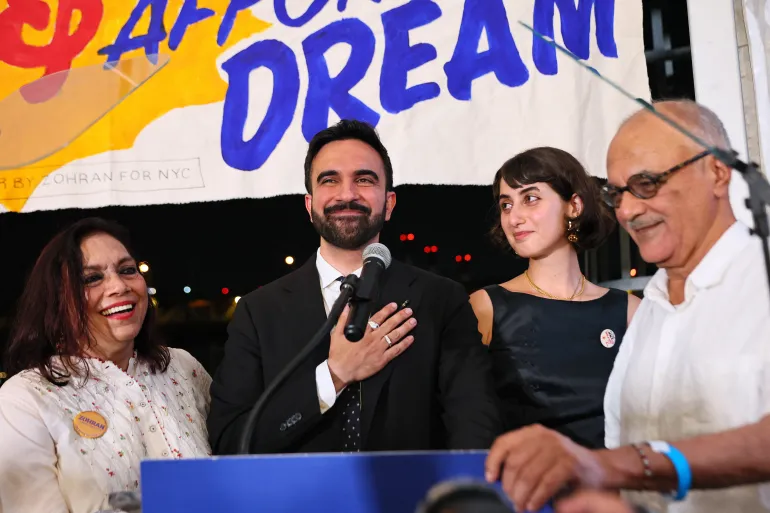
A few days before Zohran Mamdani’s decisive victory in the Democratic primary for mayor of New York, a friend and I were speculating about his chances of winning. We indulged in a moment of giddy optimism at the prospect that a Muslim man might actually become the mayor of the city we live in. With the polling available then, it seemed plausible. “If he does,” my friend, Arman Dzidzovic, said, “it’s about to get so much worse.”
Arman was referring to the wave of anti-Muslim vitriol already swelling toward Mr. Mamdani and his campaign, including suggestions that he was a terrorist sympathizer — or even a terrorist himself. Arman, a Muslim like me, felt that the higher Mr. Mamdani’s star rose, the worse the anti-Muslim racism would get. I didn’t disagree.
Sahar Aziz, a law professor at Rutgers University, has spent years studying the ways in which civil liberties have been suspended for Muslims in America after Sept. 11. She said the perceptions of Muslims as inherently Jew-hating or violent have paved the way for attacks on pro-Palestinian speech. “I say ‘Muslims’ and ‘Palestinians’ together because you cannot disconnect those two, in terms of people’s perceptions in the United States,” she told me. “The reason anti-Palestinian racism is so salient and so effective and acceptable is because it rides on the back of Islamophobia.”
Not all attacks on pro-Palestinian speech are Islamophobic, Ms. Aziz said, but the two often bleed into each other. As American institutions convulsed with protests against the Israeli campaign in Gaza, anti-Muslim language and incidents — the murder of a 6-year-old Palestinian American named Wadea Al-Fayoume, the shooting of three Palestinian college students in Vermont, dozens of incidents of mosques vandalized and threatened — were already on the rise. The attempts at suppressing pro-Palestinian speech, using antisemitism as a cudgel, were well underway by the time Mr. Trump was elected for the second time. Palestine Legal, an aid organization that supports pro-Palestinian voices facing legal action in the United States, said it received more than 2,000 requests for legal aid in 2024 alone.
With groups like Project Esther, an initiative of the Heritage Foundation (the same group that devised Project 2025) whose stated mission is to suppress pro-Palestinian speech, Ms. Aziz suggested, we are seeing something comparable to the era of the Patriot Act in the early 2000s, when the quashing of civil liberties became government policy. “It means the future may be worse,” she said. “The more institutional it becomes, the harder it is to combat.”
But the Trump administration has taken the language and institutional policies and codified them. In January, Mr. Trump issued an executive order to “combat antisemitism.” The order has given the green light for the Department of Justice to establish a multiagency antisemitism task force, which has, among other things, moved to arrest and deport or, according to the order, “otherwise hold to account” those deemed guilty of antisemitic harassment under a vague definition of what antisemitism could entail.
To read the full essay by Meher Ahmed in the New York Times, click here.


